The best way to start with InsightRollup is not the live deal. It is a deal you have already closed and know well: re-run it, see whether the engines and controls say what your team concluded at the time, and calibrate the thresholds before anything is decided with them.
A four-step plan
(anonymised export)"] --> B["2. Calibrate controls
in Rules Studio"] B --> C["3. One live deal
agents at draft"] C --> D["4. The pipeline
and integration"]
| Step | What you do | How you know it worked |
|---|---|---|
| 1. Re-run a closed deal | Import the book export you priced on. Analyze. Read the findings against the memo you wrote. | Retention, concentration and revenue agree with your analysis, or the difference is explained by a definition. |
| 2. Calibrate | Change the controls' thresholds to your acquisition policy; test each against the closed deal; publish. | The controls that fire are the ones your committee actually discussed. |
| 3. One live deal | Agents at L1 draft. The deal lead answers every prepared decision. | Agreement over answered decisions; the memo built from approved findings. |
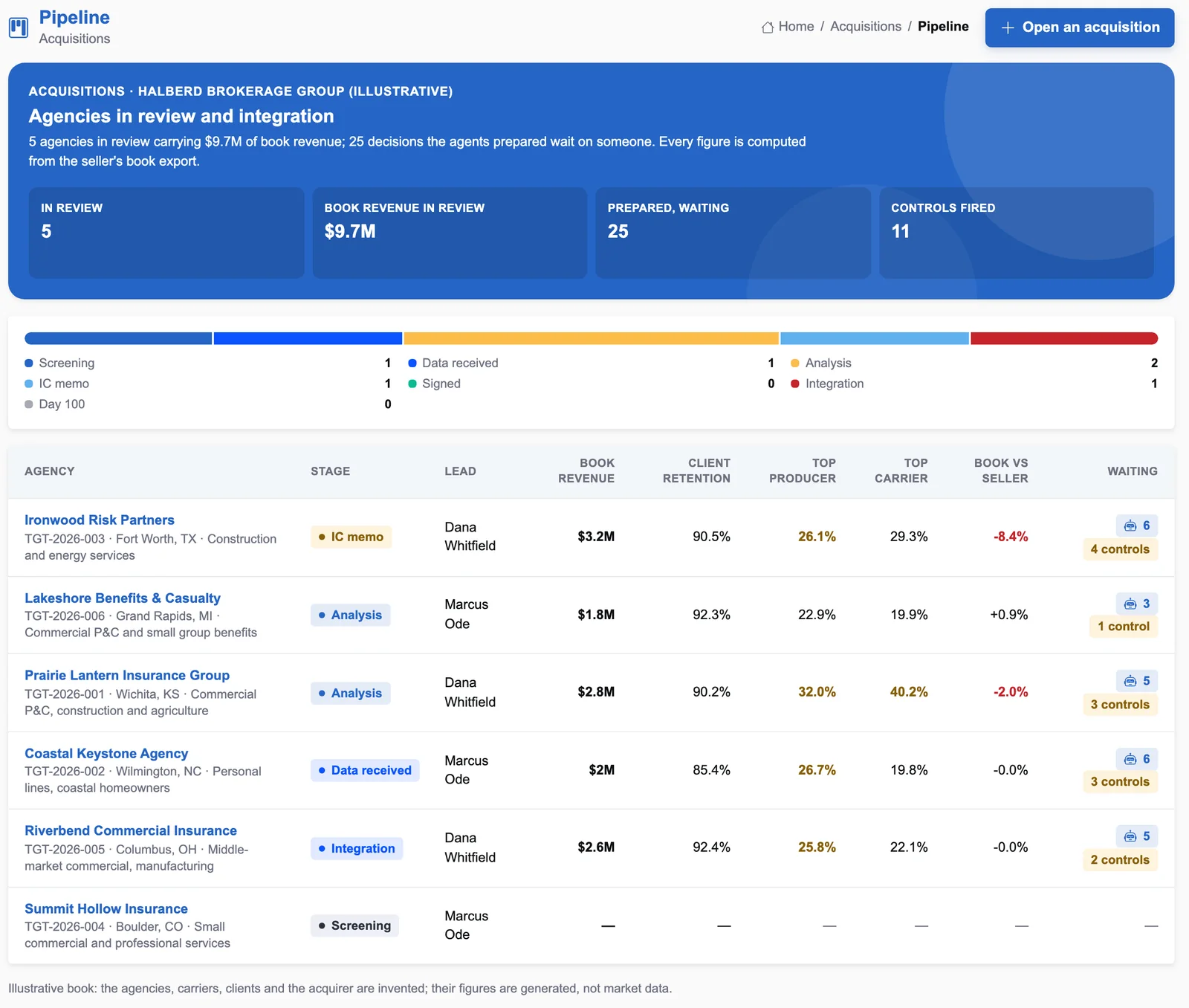
| 4. The pipeline | Every new export goes through it; integration tracked to day 100. | The practice leader's home shows the whole programme on the same measures. |

Governing it
- Traces. Every agent step records the model, tokens, cost and duration; the activity page lists every step across the pipeline.
- Prompts. Agent prompts are versioned and overlaid from InsightPrompts, so a prompt change is reviewed like a rule change.
- The model switch. Agents and copilot can be switched off independently; the product keeps working on the engines.
- The decision record. Every answer, sign-off and stage move, signed by a person.
- Tests that never call a model. The engines are tested on known-answer books; the model client is refused in tests.

For the deal team
Start on something you know the answer to, so trust is earned before it is needed.
For IT
Deploy in your cloud on your PostgreSQL; each environment has its own schema, model account and ceiling.
For corp-dev leadership
Within one deal cycle the programme has one way of measuring every agency it looks at.
Questions we get asked
Do we need clean data to start?
No. The data-quality engine is part of the product; a messy export is a finding, and the request to the seller is drafted from it.
What does a re-run of a closed deal need?
The book export the deal was priced on, the seller's revenue and the asking multiple. Anonymise client names if you prefer; the engines don't need them except for client matching.
Keep reading

Where agency acquisitions lose money
Not in the multiple. In the revenue it is applied to, and the people who hold it.
Read article
Reading a seller's book export
Rolling periods, commission not premium, and what 'retained' has to mean.
Read article
The Acquisition Workspace: one page per agency
Seven zones, one stage strip, and every citation one click from the rows.
Read article