- contact@verticalserve.com
- Every figure from the book · part of the Insight broker suite
InsightRollup · The AI-first acquisition workbench
Buy the agencies worth buying. Every figure from the book.
InsightRollup reads a seller’s book export row by row and computes what you are really buying — retention, concentration, revenue quality, renewals. Ten agents prepare the seller requests, the memo and the 100-day plan; your team decides, on the record.
6agencies in the demo pipeline, screening to day 100
3,232book rows behind one agency’s figures
10agents, every action capped at ask first
8acquisition controls in Rules Studio
Figures from the illustrative demo book: invented acquirer, agencies, carriers and clients.

Proof, not promises
Three screens from the demo pipeline, as they are
An invented acquirer is buying six invented agencies. This is what InsightRollup put in front of the deal team without being asked.


The problem
An acquisition programme runs on spreadsheets nobody can audit
A broker buying agencies sees a new book export every few weeks: a different management system, different column names, a seller’s revenue figure, a multiple. The analyst rebuilds retention and concentration by hand, the memo quotes numbers nobody can trace, and the integration plan starts the week after close.
Price
A multiple on the wrong revenue
The seller’s revenue includes contingent income and fees the book does not support. Pay the multiple on it and the gap is paid for twice.
People
The book walks with a producer
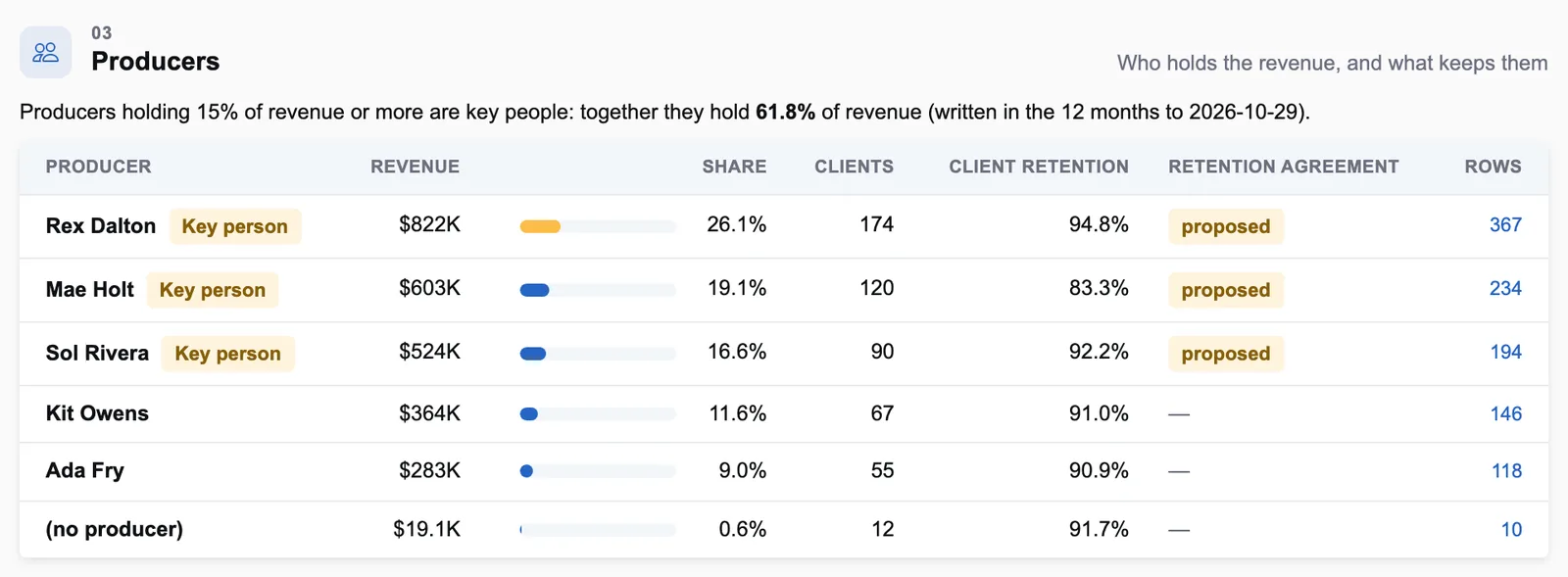
One producer holding a quarter of the revenue, without a signed retention agreement, is the largest single risk in a small-agency deal.
Carriers
Appointments found too late
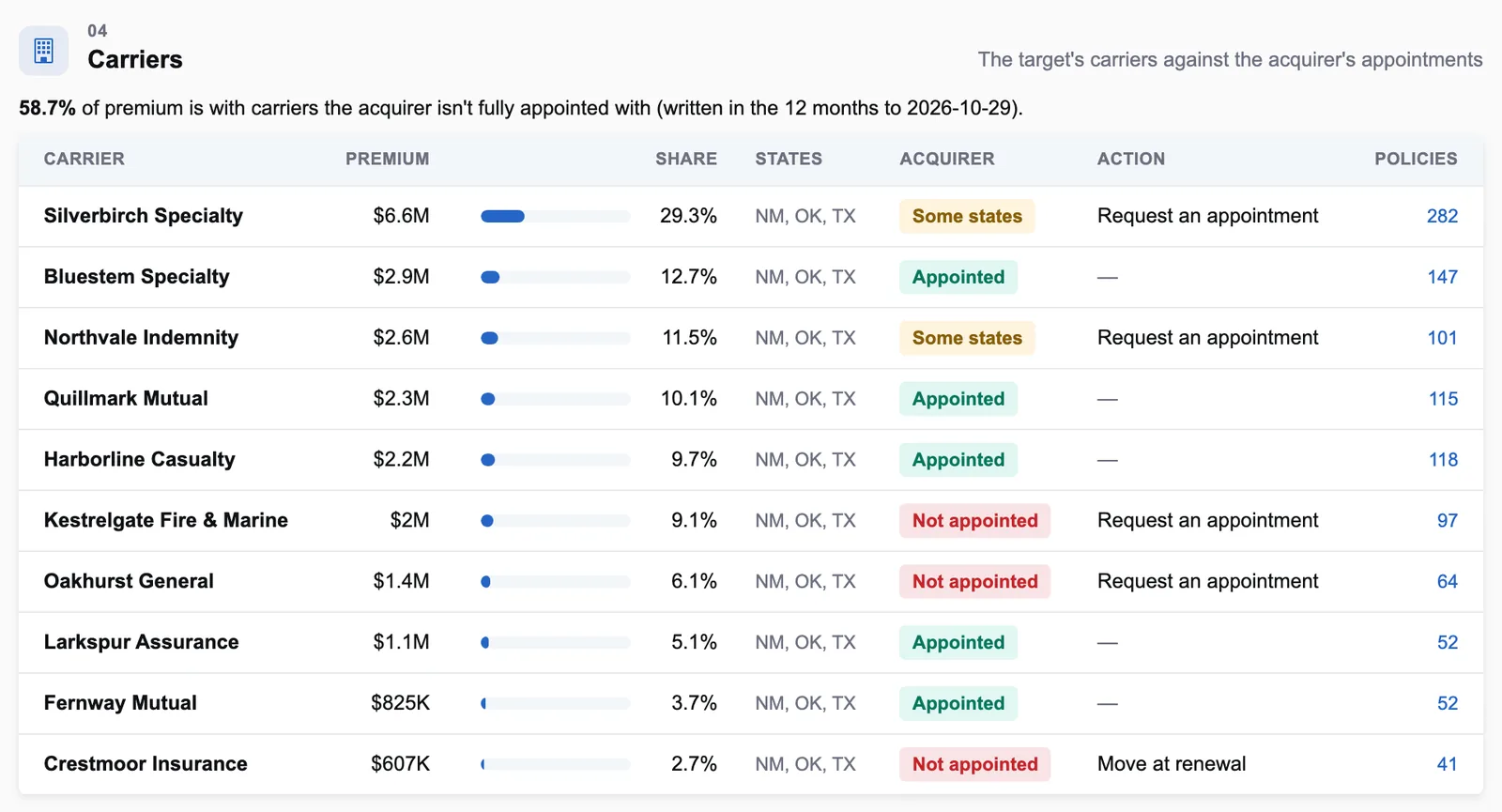
Premium with carriers the acquirer is not appointed with has to be appointed or moved, and the renewals do not wait for close.
Record
A memo nobody can trace
The investment committee approves a number. A year later, nobody can say which rows it came from or who agreed to the assumptions.
The product
Pre-deal diligence and post-close integration in one workbench
The book, the agents, the controls and the record — on one page per agency.
Book engines
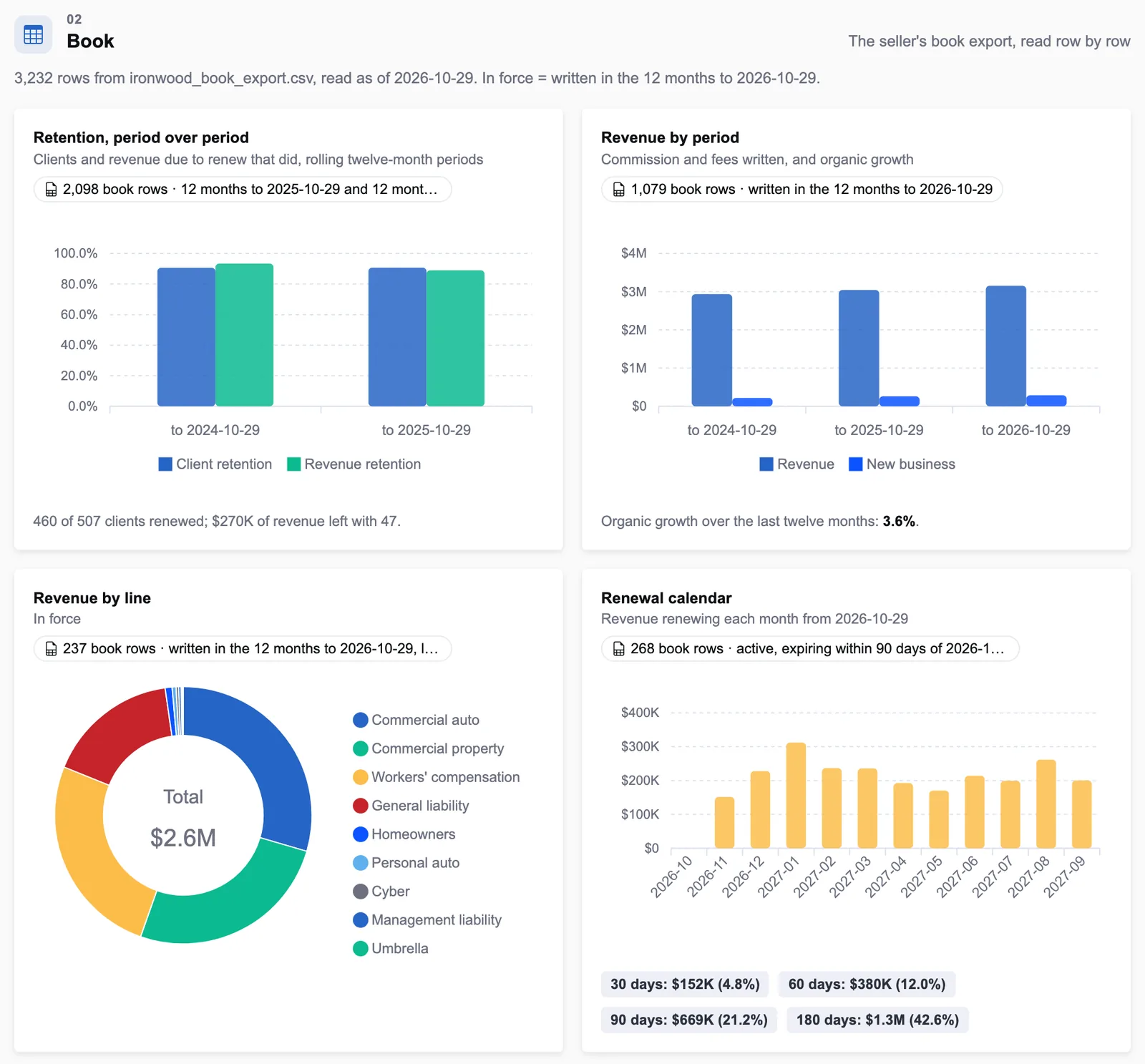
Retention, growth, concentration, revenue mix, renewals and cross-sell, computed from the seller’s rows.
Learn moreCited findings
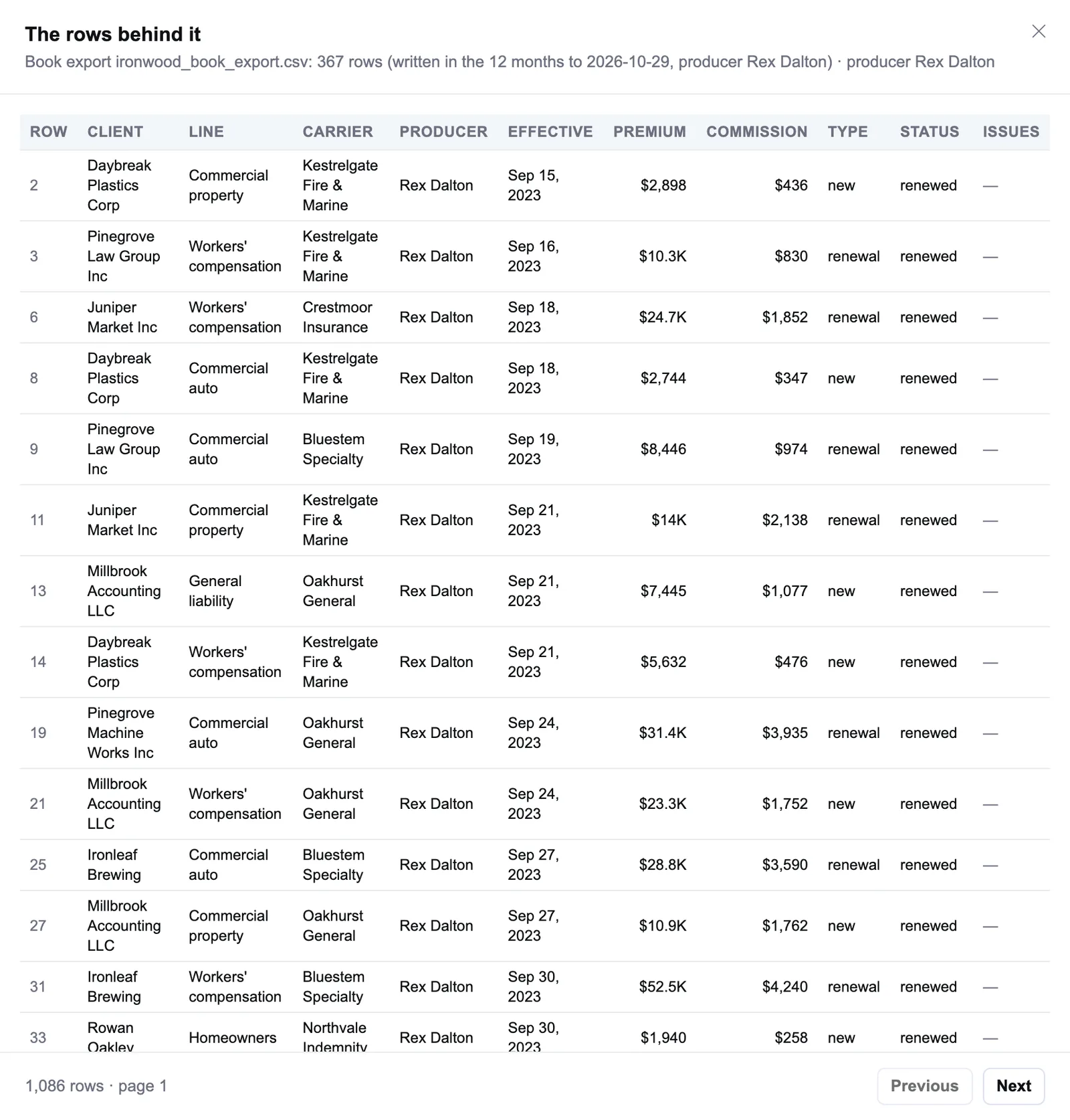
Every figure opens the exact book rows behind it, with their row numbers in the seller’s file.
Learn moreTen agents
Intake, retention, concentration, revenue, cross-sell, matching, carriers, plan, memo and supervisor.
Learn morePrepared decisions
Seller requests, retention agreements and appointment requests, ready for Accept, Reject or Ask.
Learn moreRules Studio
Acquisition policy as rules a practice leader can read, test on a real deal and publish.
Learn moreDecision record
Who agreed to what, on which figures and when — signed, and replayable for an auditor.
Learn moreIC memo
The valuation-support memo from approved findings only, with the arithmetic on each revenue base.
Learn moreDay 100
The plan becomes tasks; the retention tracker follows every client by producer and tier after close.
Learn more
How an answer is reached
From the seller’s export to a signed decision
Nothing about the price comes from a model. Every step after the import is something you can open and check.
1
Import
The seller’s CSV or XLSX, row by row onto one schema. Every row keeps its number.
2
Engines compute
Every figure, with the rows it cites. The model never computes one.
3AI
Agents reason
Ten agents explain what the figures mean for the acquirer.
4
Grounding check
An answer carrying a number not in the engines’ facts is thrown away.
5AI
Prepared
Seller requests, agreements, appointments, the plan and the memo — never sent.
6
A person decides
Accept, reject or ask. Controls refer what is outside policy to the practice leader.
Model switched off or failing: the engines’ findings stand on their own, and every prepared decision says it reasoned by rules.
Every answer, approval and sign-off is signed on the decision record. The full architecture is on How it works.
The Acquisition Workspace
One page per agency, from screening to day 100
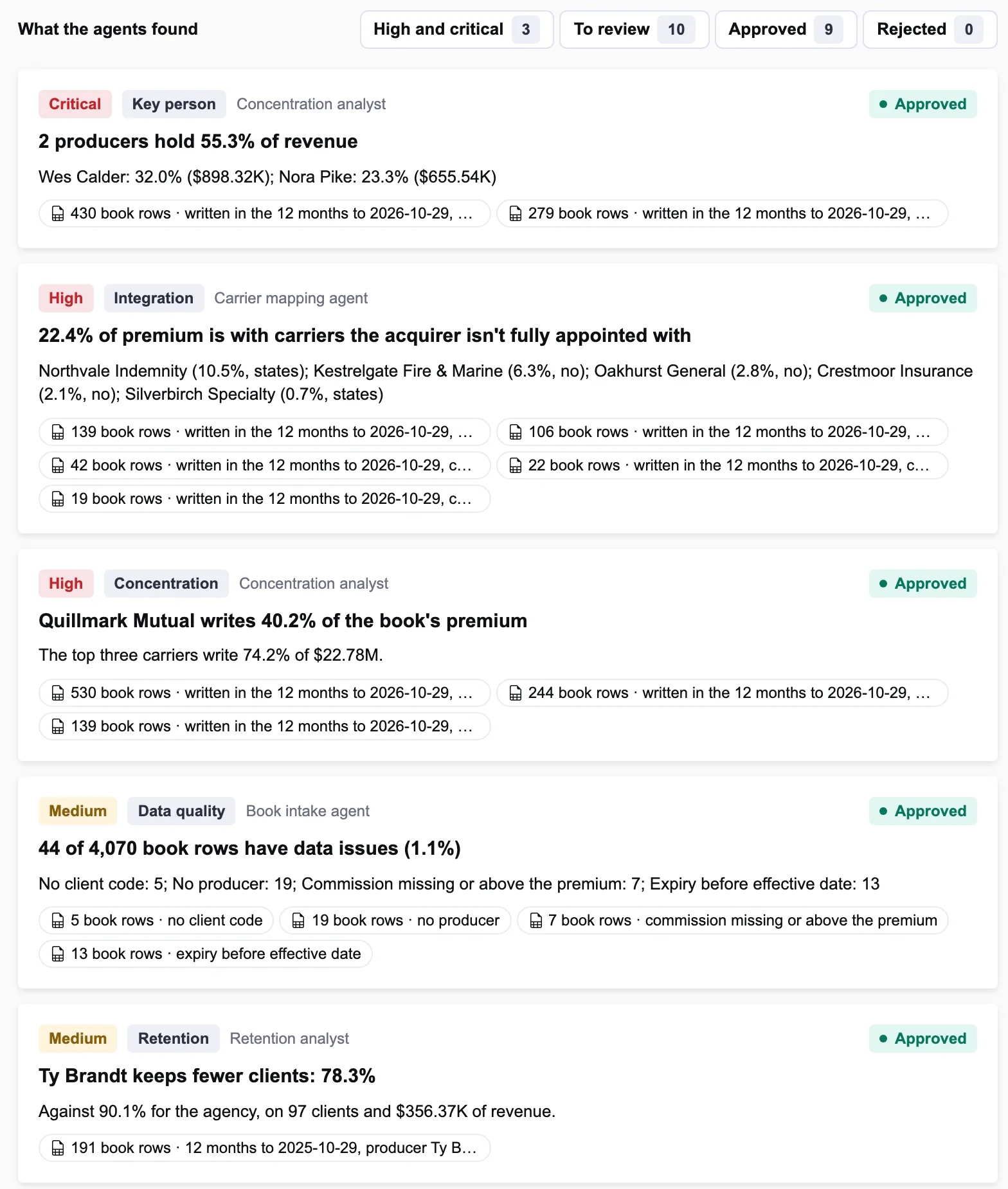
Findings, Book, Producers, Carriers, Clients, Integration and Memo — seven zones on one page, the stage strip across the top, and the acquisition controls in the rail. Every citation opens the book rows behind it.
The agents
Ten acquisition agents, each with one job and a hard limit
Book review, integration fit, memo and controls. Every action an agent can propose is capped at ask first: what goes to a seller, a carrier or an investment committee is a person’s decision.
Book intake
Data room against the checklist; data quality row by row. Drafts the request to the seller.
Retention
Client and revenue retention by producer and cohort; organic growth.
Concentration
Carrier, producer and client shares; key people. Prepares retention agreements.
Revenue quality
Recurring vs contingent; what renews in 90 days; book against the seller’s revenue.
Cross-sell
Single-line commercial clients and the acquirer’s lines they do not buy.
Client match
Exact, website, InsightPulse company graph, name similarity. A person confirms each.
Carrier mapping
Target carriers against the acquirer’s appointments. Prepares appointment requests.
Integration planner
The 100-day plan from the findings: clients, carriers, producers, systems, finance, people.
Memo writer
The valuation-support memo from approved findings only; quotes the engines’ figures.
Supervisor
Runs the acquisition controls; prepares the practice leader’s sign-off when one fires.


Controls
Acquisition policy as rules a practice leader can read
Carrier concentration over 35%, a producer over 25% of revenue, book revenue 5% below the seller’s — written in Rules Studio, tested on a real acquisition, fired on every Analyze.


The broker suite
Part of a family of broker workbenches on one platform
Shared sign-in, roster, decision record, Rules Studio and agent runtime. Company intelligence comes from InsightPulse 360 through a port, not a copy.
InInsightPulse 360Company profile, leadership, news and the parent-company link
InInsightXtractData-room documents read to text
SharedInsightDueDiligenceThe same diligence core: workspace, playbook, cited findings
InsightRollupAgency acquisitions: the book, the agents, the controls and the record
After closeInsightPlacementThe renewal calendar becomes the first renewals worked
After closeInsightProofingPolicies on the moved business checked before the client sees them
After closeInsightAdvocateThe acquired clients’ claims
Governance & deployment
Your cloud, your database, your model account
InsightRollup runs inside your environment on your PostgreSQL, with the model in your own account. Book exports are kept in your object store, never on local disk; every agent step is traced with its model, tokens and cost.
Grounded figures
The model explains; the engines compute. An answer with a number not in the cited facts is discarded and the engine’s finding stands.
Read moreA signed decision record
Every answer to a prepared decision, every finding approved for the memo and every control sign-off is signed as the person who made it.
Read moreScoped by deal
A deal lead sees the acquisitions they work; practice leaders and compliance see the programme. Rules and the dial are for leads only.
Security & deployment
From the blog
Worked examples
Acquisitions followed from the seller’s book export to the decision, on the illustrative book.

Use case
The seller’s revenue the book won’t support
An asking multiple of 2.9×, and a book 8.2% short of the seller’s figure — found before the price is agreed.
Read article
Use case
Two producers, 55% of the revenue
Key-person risk turned into retention agreements as a condition of signing.
Read article
Use case
Day 40 of the integration
97.1% of revenue retained, six tasks done, five overdue — and the plan says which.
Read article
FAQ
What corporate-development leaders ask first
Does it value the agency for us?
No. It computes what the book supports — revenue, recurring revenue, the asking multiple applied to each — and shows the arithmetic. The price is your committee’s decision, recorded as theirs.
What if the seller’s export is messy?
Columns are mapped onto one schema on import and the data-quality engine flags rows with no client code, no producer, impossible commission or reversed dates. The intake agent drafts the request for a corrected export.
Can an agent contact a seller or a carrier?
No. Requests, letters and appointment applications are prepared for a person. Every action is capped at ask first whatever the dial says, and change-of-ownership letters run as a dry run until a person sends them.
Does it work after close?
Yes. The integration planner’s 100-day plan becomes tasks with owners and dates, and the retention tracker follows each client’s transfer by producer and client tier until day 100.