An acquisition is not finished at close. It is finished when the clients have moved, the carriers are appointed, the producers are signed and the systems are merged — and whether the revenue that was bought is still there. Most programmes track that in a project plan that knows nothing about the book.
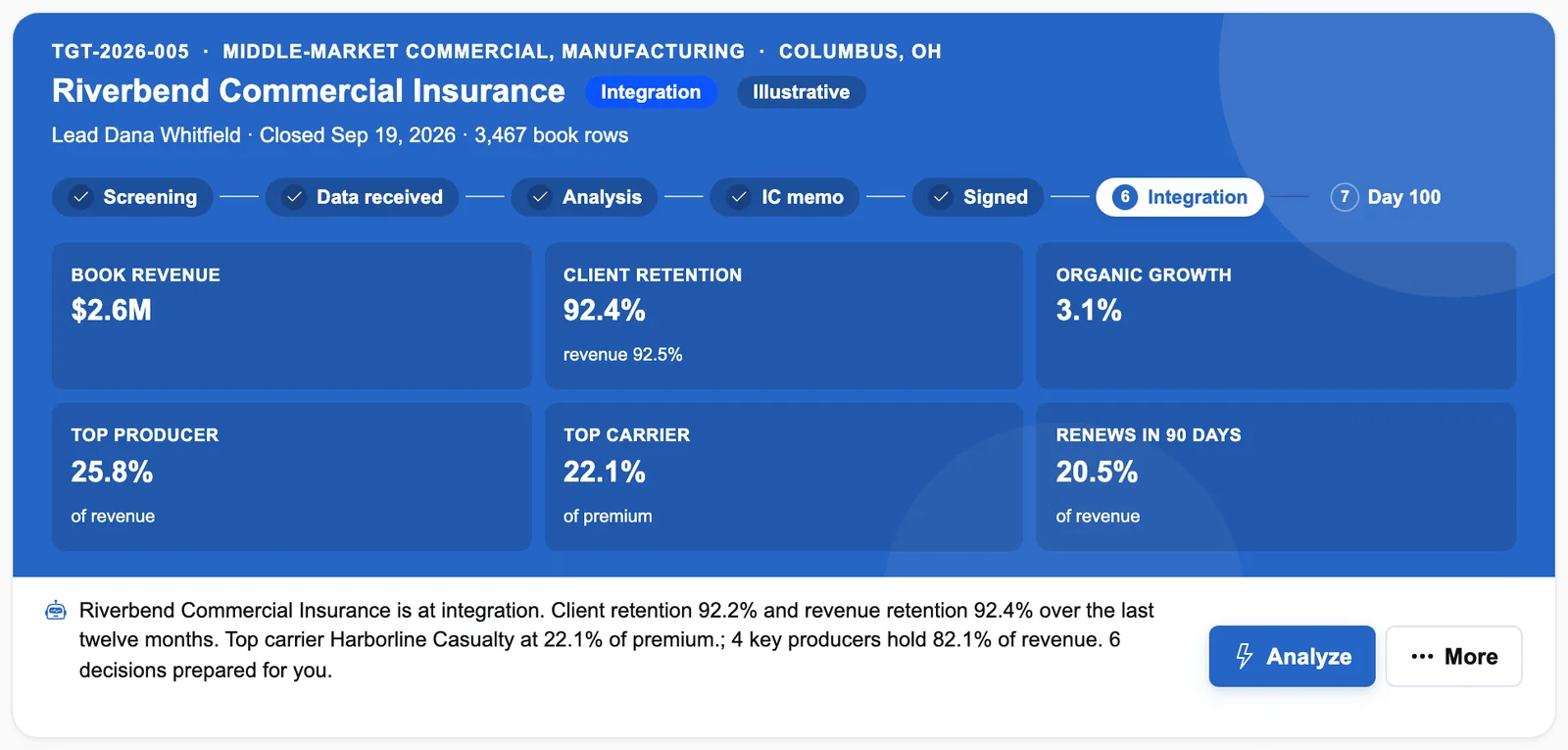
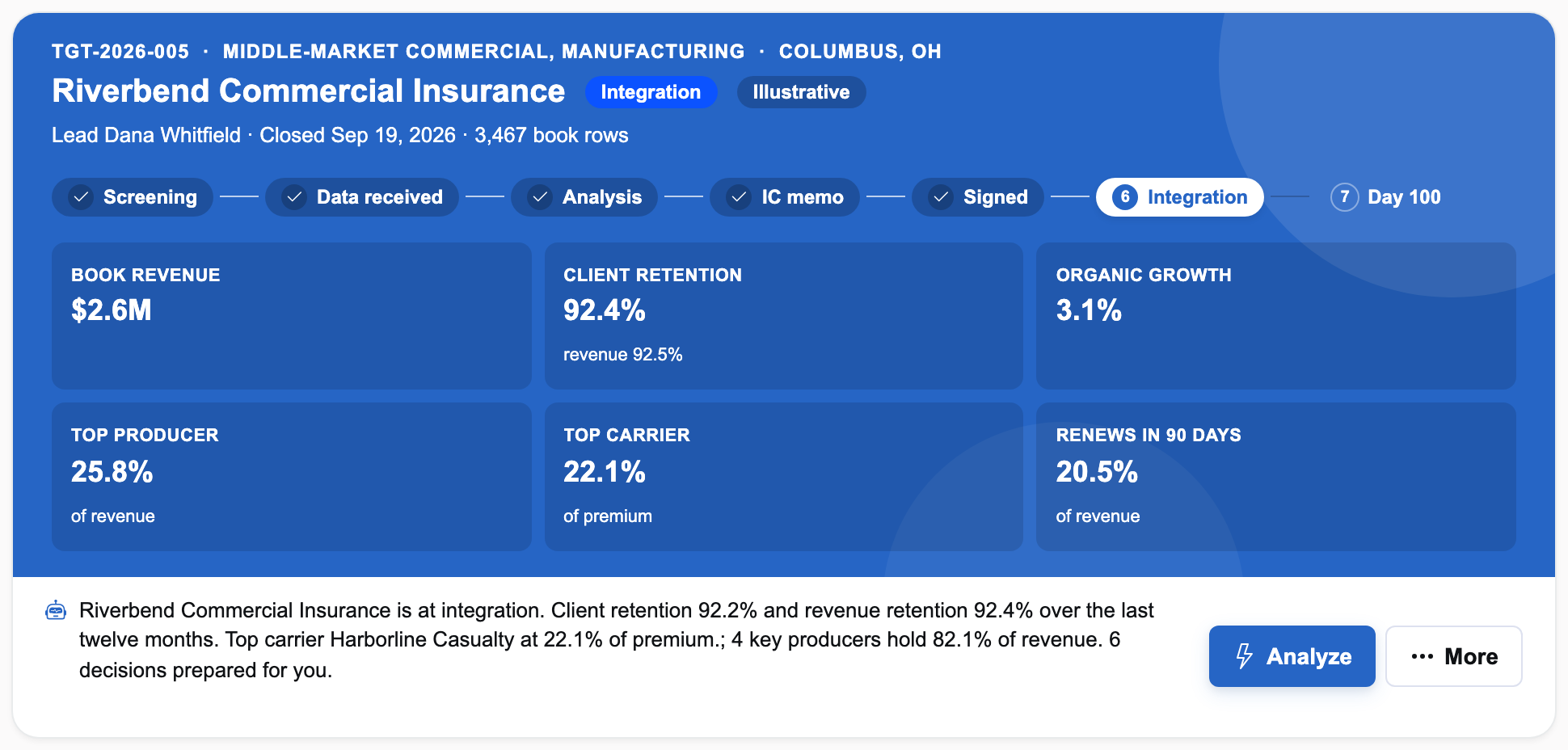
This post follows the illustrative Riverbend Commercial Insurance, a middle-market commercial agency in Columbus, at day 40 after its close: the 100-day plan adopted as tasks, the retention tracker by producer and by client tier, and the appointment tasks that are now overdue.
| Actors | Integration lead (owns the plan), deal lead, practice leader |
|---|---|
| Trigger | Close recorded; the integration planner's prepared plan adopted |
| Agency Illustrative | Riverbend Commercial Insurance — closed Sep 19, 2026; 17 tasks, 6 done |
| Agents involved | Integration planner, client match agent, carrier mapping agent |
| Stage gate | Day 100 is recorded only when every task due by day 100 is done |
| Decisions and authority | Adopting the plan (integration lead, capped at ask first); task status (task owners) |
| Outcome | Revenue retained since close, tracked by producer and client tier, with the overdue work named |
| What is measured | Revenue retained; clients transferred, mapped, pending and lost; tasks done and overdue |

The plan the findings produce
The integration planner turns the findings into tasks across six areas — producers, clients, carriers, systems, finance, people — each with a day offset from close, an owner and a reason. Key producers produce day-0 retention agreements; renewals in the first 90 days produce a day-1 protection task; unappointed carriers produce day-30 appointments; data-quality rows produce a day-45 clean-up before migration; small carrier books produce day-90 moves at renewal; the largest cross-sell gap produces a day-100 review. Tasks tied to a high-severity finding are flagged high risk.

The retention tracker

At day 40: 97.1% of revenue retained; 635 clients transferred, 264 mapped, 172 pending and 36 lost. By producer, one producer's book has lost 16 clients and retains 93.8% — the lowest. By client tier (A is the clients bringing the first half of revenue), tier A retains 96.8%, tier B 97.9%, tier C 96.6%. Illustrative figures.
The move to Integration needs the close date.
Accepting the integration planner's prepared decision creates the tasks.
Four day-0 tasks done.
Change-of-ownership letters (a dry run until a person sends them) and the renewal-protection task done.
Five tasks past their due date, shown in red on the plan and on the integration lead's home.
The lowest-retaining producer's lost clients reviewed with them.
| Agent | What it prepared | What it cites | Who decides |
|---|---|---|---|
| Integration planner | A 17-task 100-day plan across producers, clients, carriers, systems, finance and people | The approved findings and engine figures | Integration lead adopts |
| Client match agent | Confirm 2 proposed client matches before accounts are merged | Pulse evidence and name scores | Integration lead |
| Carrier mapping agent | Appointments with 3 carriers | Premium by carrier and appointment status | Integration lead |
For the deal team
The integration plan comes from the deal's own findings, and the tracker shows which producer's clients are leaving.
For IT
Tasks carry their source finding and day offset; retention is recomputed from the transfer status of each client in force at close.
For corp-dev leadership
Revenue retained since close is a live number on the practice leader's home, not a quarterly estimate.
Questions we get asked
Can we add our own tasks?
Yes. The planner's tasks are a starting point: tasks can be added to the plan, and each task's status is kept on the Integration zone.
When is the acquisition 'done'?
When every task due by day 100 is done, the move to Day 100 is allowed and recorded.
Keep reading

The seller's revenue the book won't support
An asking multiple of 2.9×, and a book 8.2% short of the seller's figure.
Read article
How InsightRollup connects to the rest of the suite
Pulse 360 for who the companies are; Placement, Proofing and Advocate for the book after close.
Read article
Putting your first acquisition through it
One closed deal you know well, re-run — then the live one.
Read article