
Every agency acquisition comes with a revenue figure from the seller and a multiple the seller would like applied to it. The multiple gets the attention in the room. The revenue figure is where the money actually goes: apply 2.9× to revenue the book does not support and the gap is paid for nearly three times over.
This post follows an illustrative agency — Ironwood Risk Partners, a construction and energy services agency in Fort Worth, invented for the demo book — from the book export to the investment-committee memo. The revenue engine finds that the book supports 8.2% less revenue than the seller states, and that 17.1% of what it does support is contingent or supplemental income. Every figure here is generated demo data, shown on the running product.
| Actors | Deal lead (owns the acquisition), analyst, practice leader (signs off what is outside policy), the investment committee |
|---|---|
| Trigger | The seller's book export imported; Analyze run at analysis and again at IC memo |
| Agency Illustrative | Ironwood Risk Partners — 3,232 book rows, seller's revenue $3.44M, asking 2.9× revenue |
| Agents involved | Revenue quality analyst, retention analyst, supervisor agent, valuation memo writer |
| Controls that fire | REVENUE_SHORTFALL (book more than 5% below the seller's — refer), VOLATILE_REVENUE (contingent and supplemental over 15% — warn) |
| Decisions and authority | Approving the findings for the memo (deal lead), the practice leader's sign-off on the referral, the price (the committee) |
| Outcome | A memo that shows the asking multiple on the seller's revenue, on the book's revenue and on recurring revenue, side by side |
| What is measured | Book revenue vs seller's revenue; recurring share; the price the multiple implies on each base |
Why the seller's number and the book's number differ
Neither side is usually lying. The seller's figure comes from the agency's accounts: commission received in a financial year, with contingent commission, supplemental income and fees in it, and sometimes a business that has since left. The book export is the policies themselves. InsightRollup computes revenue from the book — commission and fees written in the twelve months to the export date, never premium and never a half-finished calendar year — and sets it next to the seller's figure.
| Source of difference | What it looks like in the book | Who sees it |
|---|---|---|
| Contingent and supplemental income | Rows with commission type contingent or supplemental: paid by carriers on profit and volume, so it moves year to year | Revenue quality analyst |
| Lost clients still in the accounts | Clients who were due to renew in the last twelve months and did not — revenue that is not coming back | Retention analyst |
| Different periods | A financial year against twelve rolling months to the export date | The engines (every citation states its period) |
| Rows that cannot be counted | Commission missing or above the premium; rows with no client | Book intake agent |
$3.44M"] --> G{"Book vs seller"} B["Book revenue
$3.15M, 12 months
to the export date"] --> G G -->|"-8.2%"| R["REVENUE_SHORTFALL
refer to the practice leader"] B --> Q["Recurring 82.9%
contingent + supplemental 17.1%"] Q --> V["VOLATILE_REVENUE
warn: value it separately"] R --> M["Memo shows the multiple
on each base"] V --> M style R fill:#fdecec,stroke:#e57373 style V fill:#fff4e2,stroke:#f4a03a
What the screens show

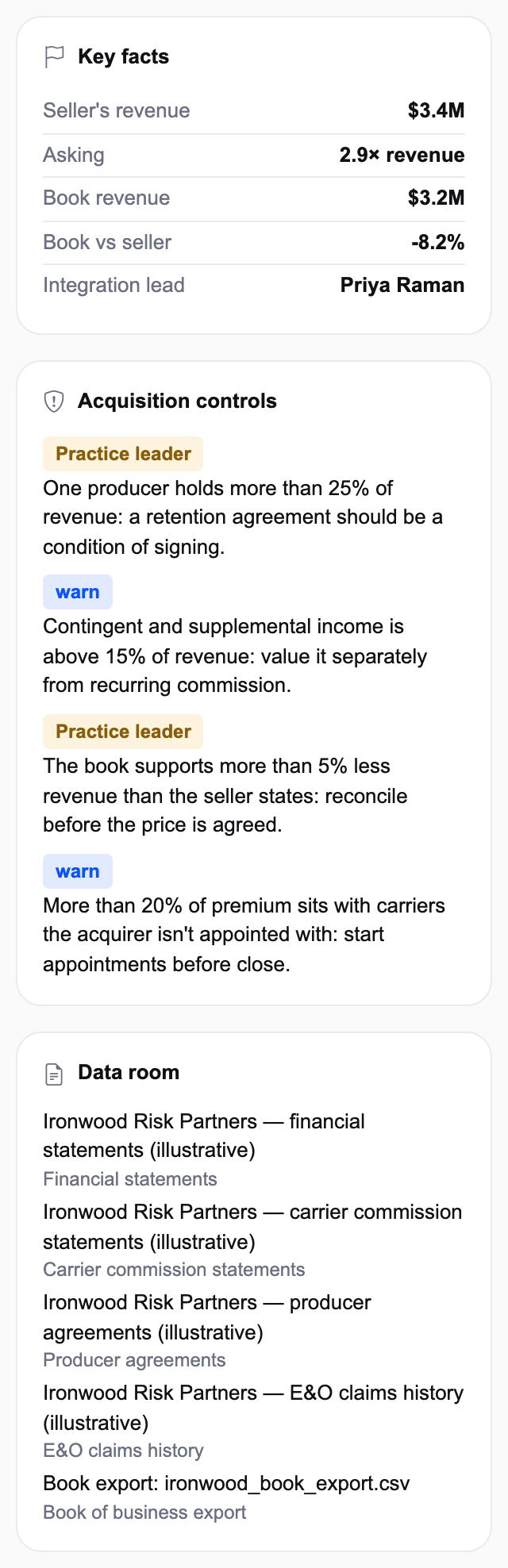
The workspace hero puts the headline figures in one row: book revenue $3.2M, client retention 90.7%, organic growth 3.6%, top producer 26.1% of revenue, top carrier 29.3% of premium, 21.2% of revenue renewing in 90 days. The rail shows the key facts — seller's revenue $3.4M, asking 2.9×, book against seller −8.2% — and the four controls that fired.

The revenue mix card is the second half of the story. Of the $3.15M the book supports, renewal
commission is 73.8% and new business 9.1%; supplemental income is 8.9% and contingent commission
8.2%. That 17.1% depends on the carriers' profit-sharing and volume bonuses, and the
VOLATILE_REVENUE control says to value it separately from recurring commission.
Step by step
ironwood_book_export.csv: 3,232 rows mapped onto one schema, each keeping its row number.
The engine: $3.15M of commission and fees written in the twelve months to the export date, 8.2% below the seller's $3.44M; 82.9% recurring. The agent's finding cites 1,079 rows.
REVENUE_SHORTFALL refers to the practice leader; VOLATILE_REVENUE warns. The supervisor agent prepares the practice leader's sign-off.
The deal lead reads each finding against its rows and approves it for the memo. Only approved findings reach the memo.
The gap goes back to the seller as a question: which accounts carry the difference, and how much of it is contingent income from which carriers.
The memo opens with the valuation arithmetic: 2.9× on the seller's revenue is $9.97M; the same multiple on the book's recurring revenue is $7.59M.
The sign-off on the referral is answered on the decision record, with a note. Signing cannot be recorded while it waits.
The arithmetic, as the memo shows it
| Base | Revenue | At 2.9× |
|---|---|---|
| The seller's revenue | $3.44M | $9.97M |
| The book's revenue (12 months to the export date) | $3.15M | — (shown in the memo header) |
| The book's recurring revenue | $2.6M | $7.59M |
The memo does not propose a price. It shows what each base implies, cites the rows, and leaves the number to the committee. All figures above are the illustrative book's.

Who talks to whom
What the agents prepared, and what each rests on
| Agent | What it prepared | What it cites | Who decides |
|---|---|---|---|
| Revenue quality analyst | The book supports $3.15M of revenue, 8.2% below the seller's $3.44M; 82.9% recurring, 17.1% contingent or supplemental | 1,079 book rows written in the 12 months to the export date; rows by commission type | Deal lead approves for the memo |
| Retention analyst | Client retention 90.7%, revenue retention 89.0%: 460 of 507 clients due to renew did; $269.94K left with the 47 that didn't | 2,098 rows across two rolling periods | Deal lead |
| Supervisor agent | Practice leader sign-off: two controls fired that refer | The acquisition controls and the engine figures they read | Practice leader |
| Valuation memo writer | The valuation-support memo from the approved findings | Approved findings only; the engines' figures quoted | Deal lead finalizes |
On the decision record
| Section | Hit | Outcome |
|---|---|---|
| Revenue | REVENUE_SHORTFALL: book revenue against the seller's −8.2% | refer |
| Revenue mix | VOLATILE_REVENUE: contingent and supplemental 17.1% | warn |
| Key people | KEY_PRODUCER: top producer 26.1% of revenue | refer |
| Carriers | UNAPPOINTED_CARRIERS: 58.7% of premium not fully appointed | warn |
For the deal team
You stop rebuilding revenue in a spreadsheet. The gap is on the screen with its rows, and the question for the seller writes itself.
For IT
Revenue is computed in pandas from the stored rows; each figure carries a citation (file, row count, filter). The model never produces it.
For corp-dev leadership
The committee sees the multiple applied to three bases, and who signed off the referral, before it agrees a price.
Questions we get asked
Is the seller's figure wrong?
Not necessarily. It is usually a different period, with contingent income and fees in it. The point is to see the difference and ask about it before the price is agreed.
Can we change the 5% threshold?
Yes. REVENUE_SHORTFALL is a rule in Rules Studio; a practice leader can change it, test it against a live acquisition and publish a new version.
Does the memo recommend a price?
No. It shows the arithmetic on each base and the cited findings. The price is the committee's decision.
Keep reading

Two producers, 55% of the revenue
Key-person risk turned into retention agreements before signing.
Read article
How InsightRollup connects to the rest of the suite
Pulse 360 for who the companies are; Placement, Proofing and Advocate for the book after close.
Read article
Putting your first acquisition through it
One closed deal you know well, re-run — then the live one.
Read article