
In a small agency the book does not belong to the agency so much as to the people who write it. When one producer holds a third of the revenue, the question is not whether the book is good. It is whether that person will still be there in a year, and whether their agreement stops the clients following them if they are not.
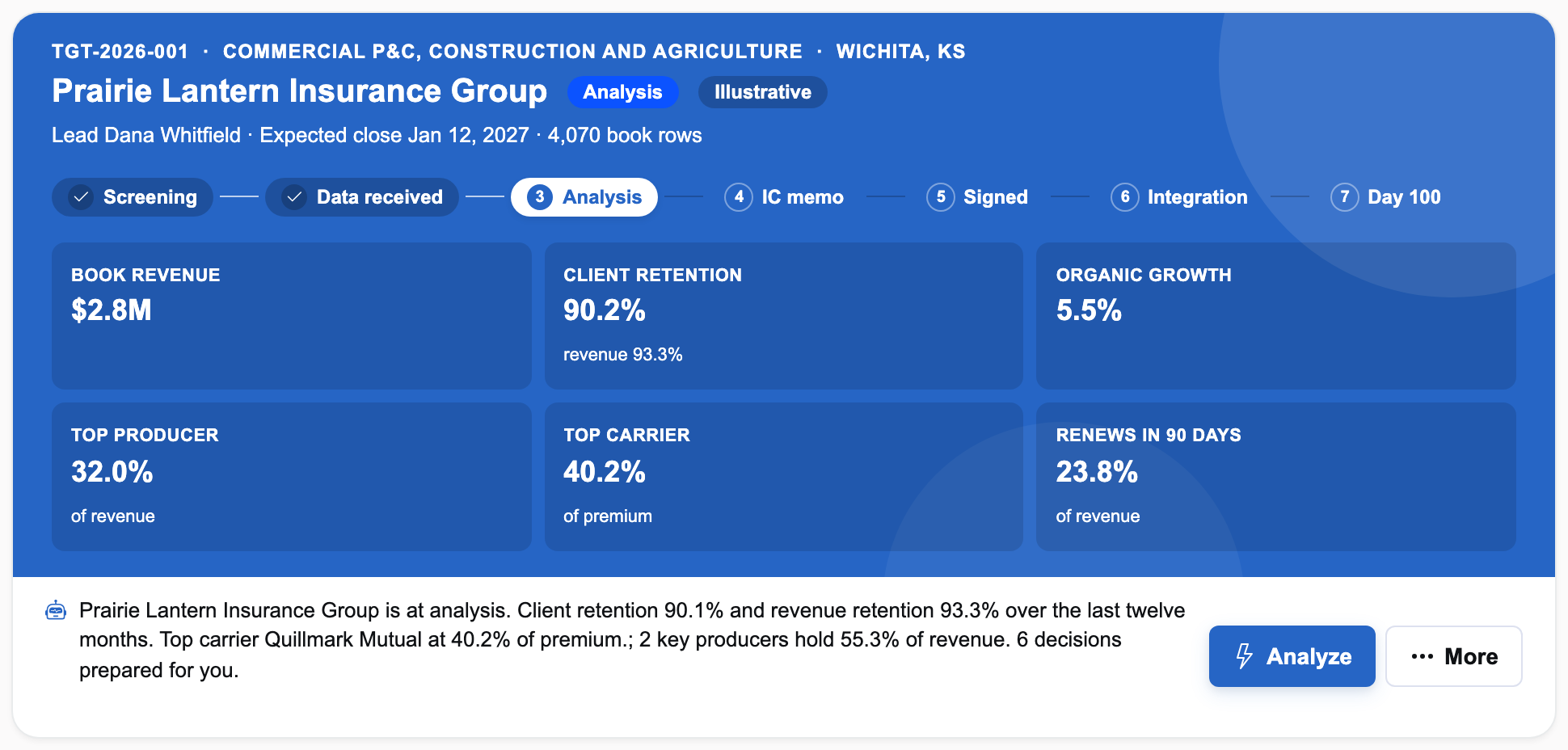
This post follows the illustrative Prairie Lantern Insurance Group — a
commercial P&C, construction and agriculture agency in Wichita, invented for the demo —
where two producers hold 55.3% of revenue and a third keeps markedly fewer clients
than the agency does. The concentration analyst finds it, prepares retention agreements, and the
KEY_PRODUCER control makes them a condition of signing.
| Actors | Deal lead, practice leader, the seller's principal, the key producers |
|---|---|
| Trigger | Analyze at the analysis stage |
| Agency Illustrative | Prairie Lantern Insurance Group — 4,070 book rows, book revenue $2.8M |
| Agents involved | Concentration analyst, retention analyst, supervisor agent, integration planner |
| Controls that fire | KEY_PRODUCER (one producer over 25% of revenue — refer to the practice leader) |
| Decisions and authority | Proposing retention agreements (deal lead, capped at ask first), the sign-off (practice leader) |
| Outcome | Retention agreements proposed for the key producers, tracked on the Producers zone and carried into the day-0 tasks |
| What is measured | Revenue share per producer; key people at 15% or more; client retention per producer; agreement status |
How the engine defines a key person
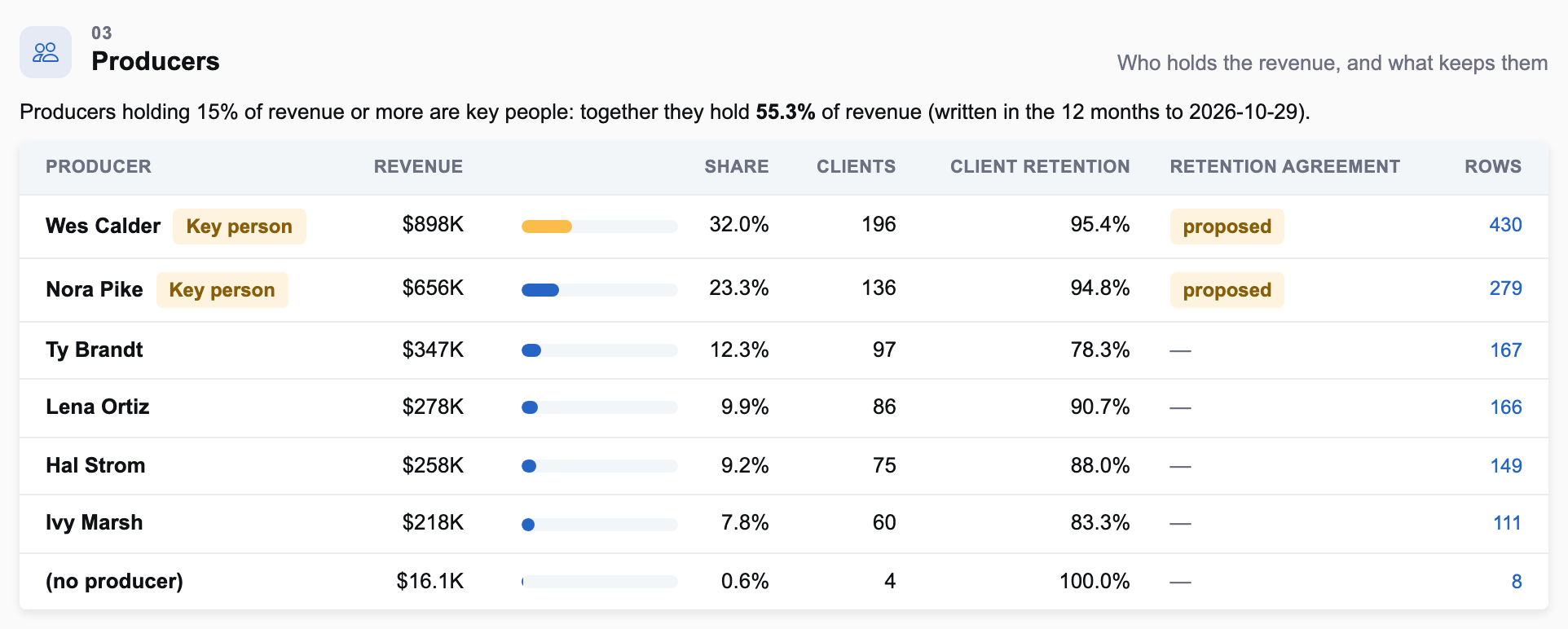
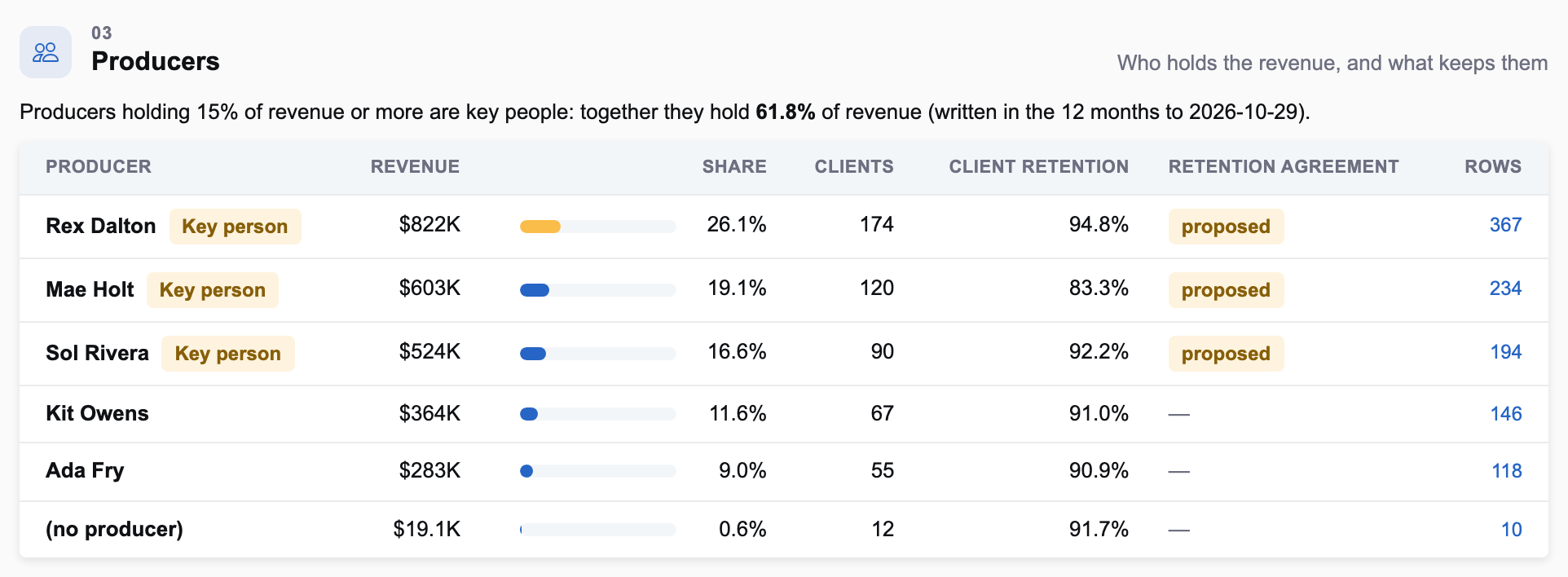
A producer holding 15% of revenue or more is a key person. Shares are of revenue (commission and fees), not premium, over the twelve months to the export date — what leaves if they leave. The engine also computes each producer's client retention: the share of their clients due to renew in the last period who did.
12 months to the export date"] --> S["Revenue by producer"] S --> K{"Share at least 15%?"} K -->|"yes"| KP["Key person"] K -->|"no"| O["Other producers"] KP --> T{"Any over 25%?"} T -->|"yes"| C["KEY_PRODUCER control:
refer to the practice leader"] KP --> RA["Concentration analyst prepares
retention agreements"] B --> RP["Client retention
by producer"] RP --> W["Retention analyst: a producer
keeping fewer clients"] style C fill:#fdecec,stroke:#e57373 style RA fill:#e3f7ef,stroke:#10a37f
What the agents found
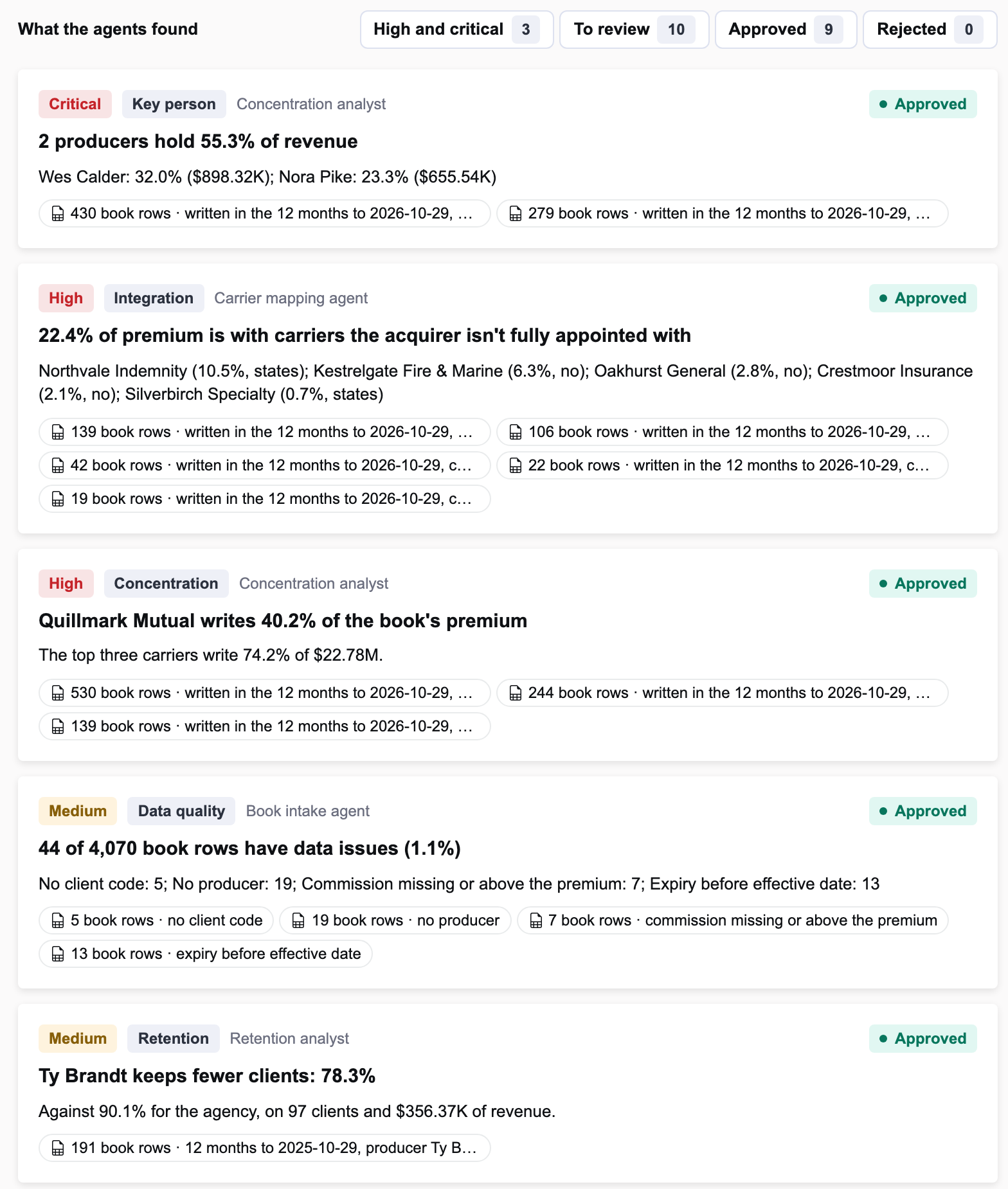
Two findings matter most here. The concentration analyst's critical finding: two producers hold 55.3% of revenue — Wes Calder 32.0% ($898.32K) and Nora Pike 23.3% ($655.54K), each cited to their rows. And the retention analyst's: Ty Brandt keeps fewer clients, 78.3%, against 90.1% for the agency, on 97 clients and $356.37K of revenue. One is a dependency; the other is a book that may already be leaking.
Step by step
Revenue by producer from 4,070 rows; two key people above 15%, one above 25%.
One producer at 78.3% client retention against 90.1% for the agency; cited to 191 rows of the prior period.
The control refers to the practice leader: a retention agreement should be a condition of signing.
A prepared decision lists each key producer with share and revenue. Capped at ask first.
Accepting marks each agreement proposed on the Producers zone. The deal lead's answer and note go to the decision record.
The playbook asks whether the existing producer agreements protect the book — non-solicitation and ownership of expirations — and cites the data-room pages that speak to it.
The 100-day plan puts each signature on day 0, flagged high risk.
The agreement's life
The Producers zone shows each key person's agreement status — none yet, proposed, signed or declined — and the copilot's concentration lookup reads the same status, so “where are key producers unprotected?” has one answer.
What the agents prepared
| Agent | What it prepared | What it cites | Who decides |
|---|---|---|---|
| Concentration analyst | Two producers hold 55.3% of revenue; retention agreements proposed for each | 430 and 279 book rows written in the 12 months to the export date | Deal lead |
| Retention analyst | One producer keeps 78.3% of clients against 90.1% for the agency | 191 book rows in the prior period for that producer | Deal lead |
| Supervisor agent | Practice leader sign-off: KEY_PRODUCER fired | The control and the share it read | Practice leader |
| Integration planner | Day-0 tasks to sign each agreement, flagged high risk | The approved findings | Integration lead |
| Section | Hit | Outcome |
|---|---|---|
| Key people | KEY_PRODUCER: top producer 32.0% of revenue | refer |
| Carriers | CARRIER_CONCENTRATION: one carrier 40.2% of premium | refer |
| Carriers | UNAPPOINTED_CARRIERS: 22.4% of premium not fully appointed | warn |
For the deal team
The conversation with the seller about the key producers starts on day one of analysis, not in the last week before signing.
For IT
Agreement status is a column on the producer row, set only by a person's answer; the engine never infers it.
For corp-dev leadership
A key-person dependency becomes a condition of signing with a named owner, not a line in the memo's risks section.
Questions we get asked
Why 15% and 25%?
15% is the engine's key-person line (KEY_PERSON_SHARE); 25% is the shipped control's threshold. A practice leader can change the control in Rules Studio.
Does the agent draft the agreement itself?
No. It prepares the decision to propose one, with the producers and their shares. The agreement is your legal team's document.
Keep reading
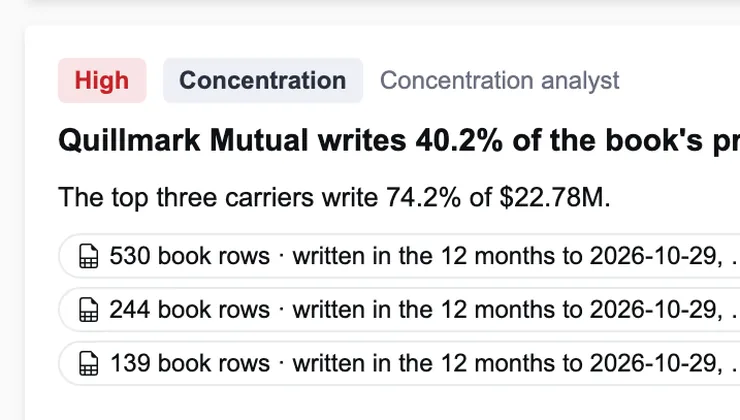
One carrier writes 40% of the book
Carrier concentration, the contingent agreement, and what to check before pricing.
Read article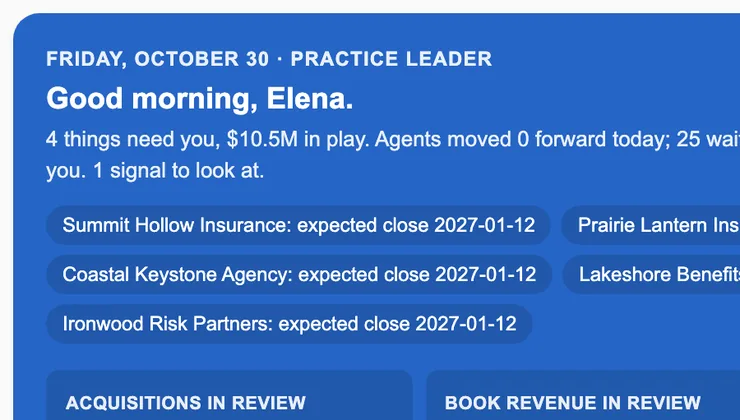
How InsightRollup connects to the rest of the suite
Pulse 360 for who the companies are; Placement, Proofing and Advocate for the book after close.
Read article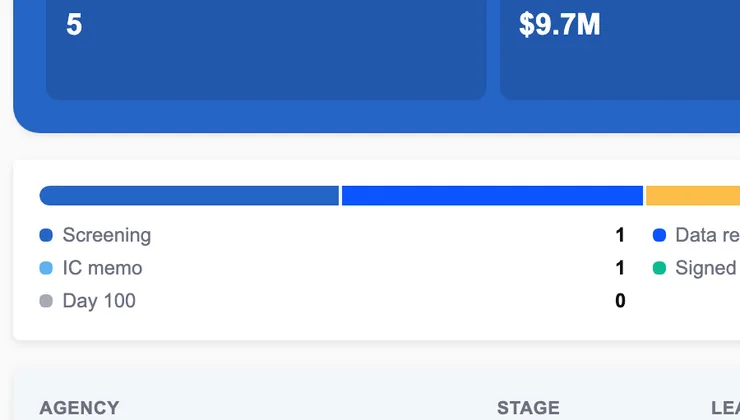
Putting your first acquisition through it
One closed deal you know well, re-run — then the live one.
Read article