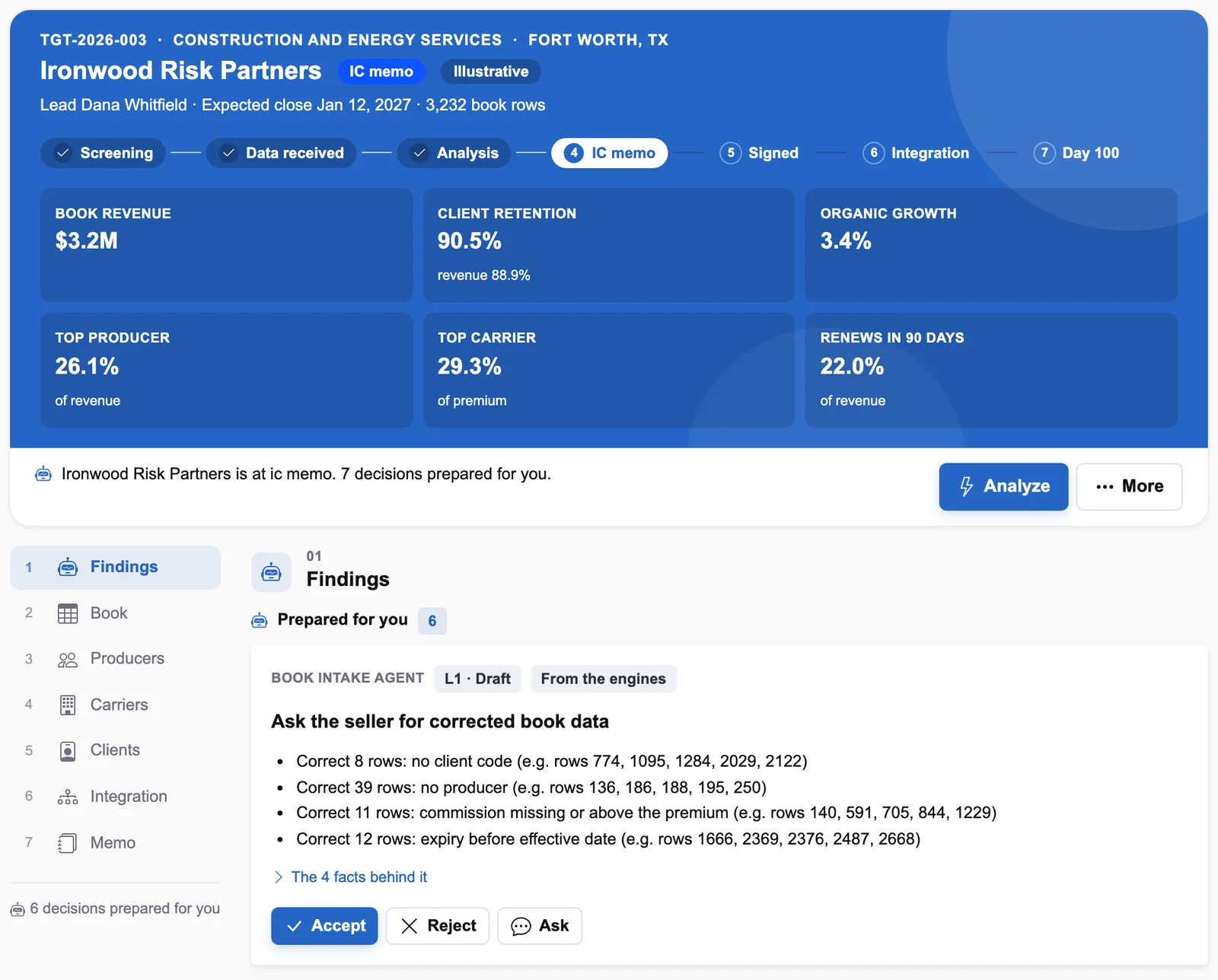
The investment-committee memo is the one document an acquisition is remembered by. It is also, too often, the least traceable: figures pasted from a spreadsheet that has since changed, risks summarised from conversations nobody wrote down, and no record of who agreed the assumptions.
InsightRollup builds the memo the other way round. The memo writer drafts it only from findings a person has approved for the memo; every figure is the engines'; every section cites the rows; and the stage machine will not record a signing until the memo is final and the practice leader has answered every control that referred. This post follows the illustrative Ironwood Risk Partners through that sequence.
| Actors | Deal lead (approves findings, finalizes), practice leader (signs off controls), investment committee |
|---|---|
| Trigger | Moving from analysis to IC memo; Analyze with the memo step |
| Agency Illustrative | Ironwood Risk Partners — 8 findings approved, 10 still to review |
| Agents involved | Valuation memo writer, supervisor agent (and every review agent's findings) |
| Stage gates | IC memo needs one approved finding; Signed needs a final memo, no blocking control and no sign-off waiting |
| Decisions and authority | Approve/reject each finding (deal lead); sign-off (practice leader); finalize (deal lead, capped at ask first) |
| Outcome | A final valuation-support memo, and a decision record showing who approved what |
| What is measured | Findings approved vs to review; controls answered; time from analysis to final memo |
The order the stage machine enforces
Stages move one at a time, and each move names what stops it. A closed acquisition cannot go back before close. Every move is an audit row with who made it.
Approving findings for the memo
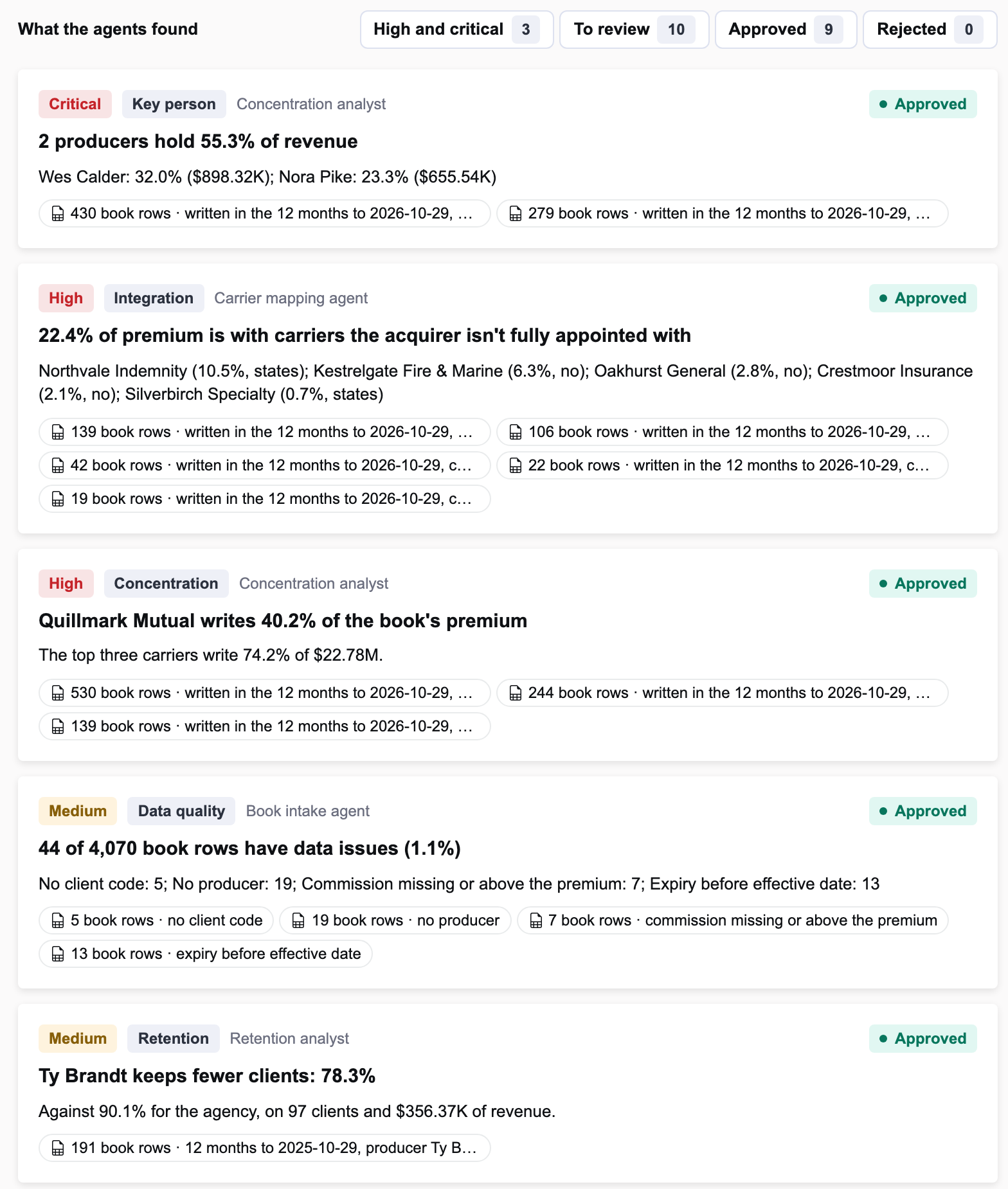
Each finding has two buttons: Approve for the memo and Reject. Approval is the deal lead's statement that the finding is right and belongs in front of the committee. Pending findings — company news, industry context, the producer-agreements search — stay out until someone reads them.
The memo

The header carries the valuation arithmetic: book revenue (12 months) $3.2M, recurring $2.6M, the seller's $3.4M, book against seller −8.2%, the asking 2.9× on the seller's revenue ($10M) and the same multiple on recurring revenue ($7.6M). Then the sections from the pack's report template — the agency and the data, retention and growth, concentration and key people, revenue quality and the seller's revenue, cross-sell, integration fit — each built from the approved findings in it, with sources. A section with nothing approved says so.
for the memo?"} A -->|"yes"| S["Memo sections
(report template)"] A -->|"no / pending"| X["Left out"] E["Engine figures"] --> H["Valuation arithmetic
header"] S --> D["Draft memo"] H --> D D --> FN{"Deal lead
finalizes"} FN --> FM["Final memo"] FM --> SG{"Signed?"} C["Controls answered
by the practice leader"] --> SG
Eight approved after reading each against its rows; ten left to review.
Allowed: at least one approved finding exists.
Built from the eight approved findings; quotes the engines' figures; prepares finalizing it.
Two controls that refer: the practice leader's sign-off is prepared.
Answered with a note; the decision record keeps who, when and why.
Accepting the memo writer's prepared decision; capped at ask first.
Refused while the memo is a draft or a sign-off waits.
| Agent | What it prepared | What it cites | Who decides |
|---|---|---|---|
| Valuation memo writer | Finalize the valuation-support memo: 8 approved findings; book revenue $3.15M in the last twelve months | Approved findings; 14 facts | Deal lead |
| Supervisor agent | Practice leader sign-off: 2 controls fired | 4 facts: the controls and their figures | Practice leader |
| Section | Hit | Outcome |
|---|---|---|
| Revenue | REVENUE_SHORTFALL −8.2% | refer |
| Key people | KEY_PRODUCER 26.1% | refer |
| Revenue mix | VOLATILE_REVENUE 17.1% | warn |
| Carriers | UNAPPOINTED_CARRIERS 58.7% | warn |
For the deal team
The memo writes itself from what you approved, and the gates stop the signing being recorded out of order.
For IT
The memo is a diligence report from the pack's ic_memo template; sections pull approved findings by playbook section.
For corp-dev leadership
A year later, anyone can see which rows each figure came from and who agreed to each finding and sign-off.
Questions we get asked
Can we use our own memo template?
The memo sections come from the agency-acquisition pack's report template, which is configuration: the sections and what feeds each can be changed for your committee.
Does the model write the memo?
With a model configured, the memo writer explains and connects the approved findings in prose; every number still comes from the engines and an ungrounded answer is thrown away. With the model off, the memo is assembled from the findings as they stand.
Keep reading

Day 40 of the integration
97.1% of revenue retained, six tasks done, five overdue — and the plan says which.
Read article
How InsightRollup connects to the rest of the suite
Pulse 360 for who the companies are; Placement, Proofing and Advocate for the book after close.
Read article
Putting your first acquisition through it
One closed deal you know well, re-run — then the live one.
Read article