InsightRollup's ten agents run in order on one pipeline when someone presses Analyze. Each runs as itself, at its own autonomy level, reads the engines' facts for its part of the playbook, reasons over them with the model when one is configured, and prepares at most one decision for a person. None of them is the source of a number.
Three steps, ten agents
| Agent | Step | What it reads and finds | What it may prepare | Never invents |
|---|---|---|---|---|
| Book intake | Book review | Data room against the checklist; data quality; company profile, leadership and news from InsightPulse | Ask the seller for missing documents and corrected data | A document or row the seller didn't send |
| Retention analyst | Book review | Client and revenue retention by producer and cohort; organic growth | — | A retention rate |
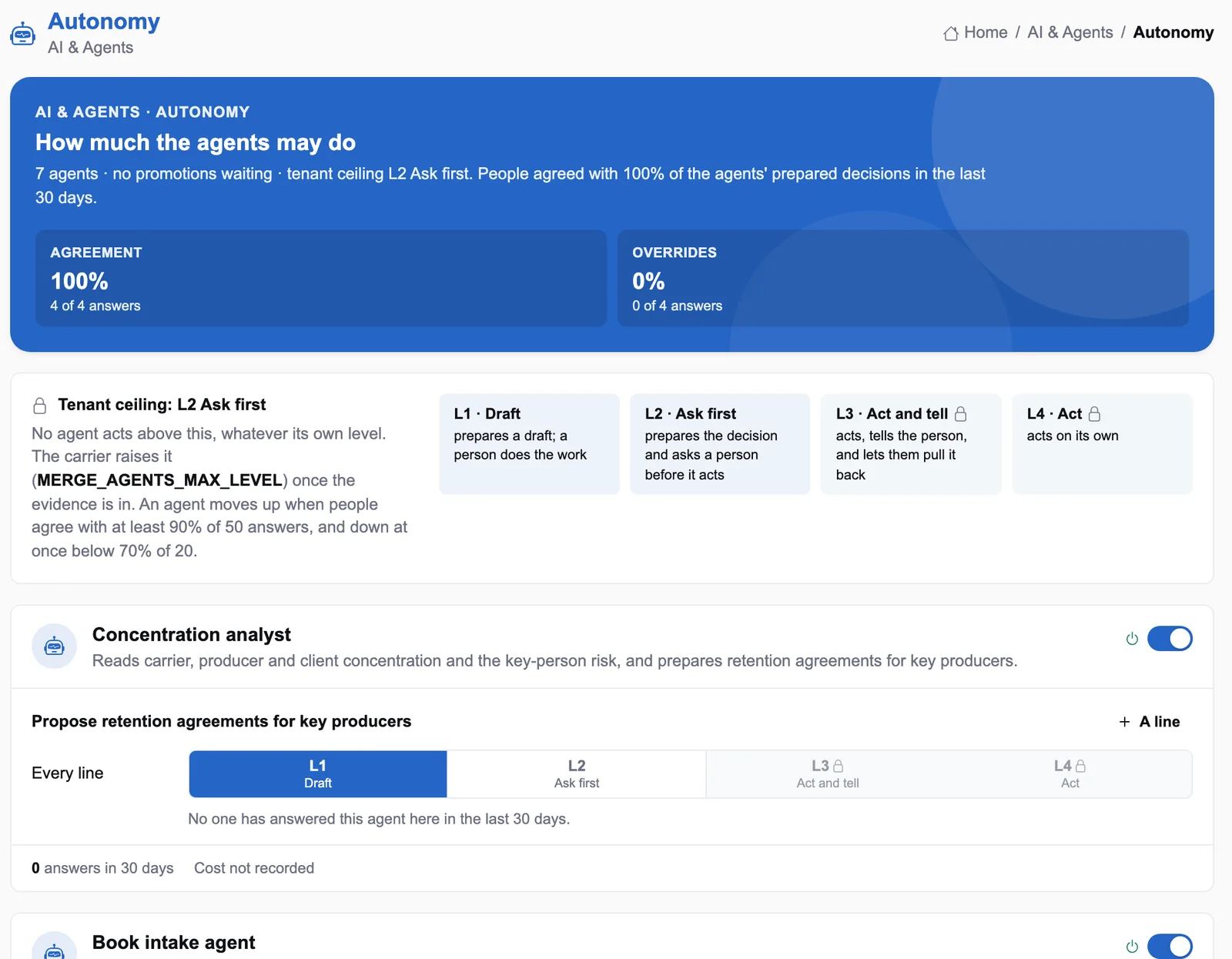
| Concentration analyst | Book review | Carrier, producer and client concentration; key people; producer agreements | Propose retention agreements for key producers | A share |
| Revenue quality analyst | Book review | Recurring vs contingent; renewals in 90 days; book against the seller's revenue | — | Revenue or a price |
| Cross-sell analyst | Book review | Single-line commercial clients; the acquirer's lines they don't buy | — | — (the estimate is the engine's) |
| Client match agent | Integration fit | The target's clients against the acquirer's: exact, website, Pulse, name | Confirm the proposed client matches | A match |
| Carrier mapping agent | Integration fit | The target's carriers against the acquirer's appointments | Request carrier appointments | — |
| Integration planner | Integration fit | The findings and engine figures | Adopt the 100-day plan as tasks | — |
| Valuation memo writer | Memo & controls | The approved findings | Finalize the valuation-support memo | A figure |
| Supervisor agent | Memo & controls | The acquisition controls | The practice leader's sign-off | — |

One run
Each step is stored: the agent, its level, whether the model ran, the model, tokens, cost and how long it took. A prepared decision supersedes any still-open one for the same agent and action, so there is one live ask per action.

The trace above was captured with the model switched off, which is a useful thing to see: the agent's own engine findings stand, the trace says so in words, and what is prepared is unchanged. With a model configured the middle step shows the model, tokens, cost and the reasoning, all grounded in the same facts.

For the deal team
Ten specialists who never get tired of rebuilding the same analysis, and never send anything.
For IT
Agents are a catalogue on the shared insight_agents runtime: registry, pipeline, run store, autonomy service.
For corp-dev leadership
Every agent step is traceable and costed; every action they can propose waits for a person.
Keep reading

Grounded figures: the model is never the source of a number
The engines compute, the model explains, and an ungrounded answer is thrown away.
Read article
The seller's revenue the book won't support
An asking multiple of 2.9×, and a book 8.2% short of the seller's figure.
Read article
Two producers, 55% of the revenue
Key-person risk turned into retention agreements before signing.
Read article