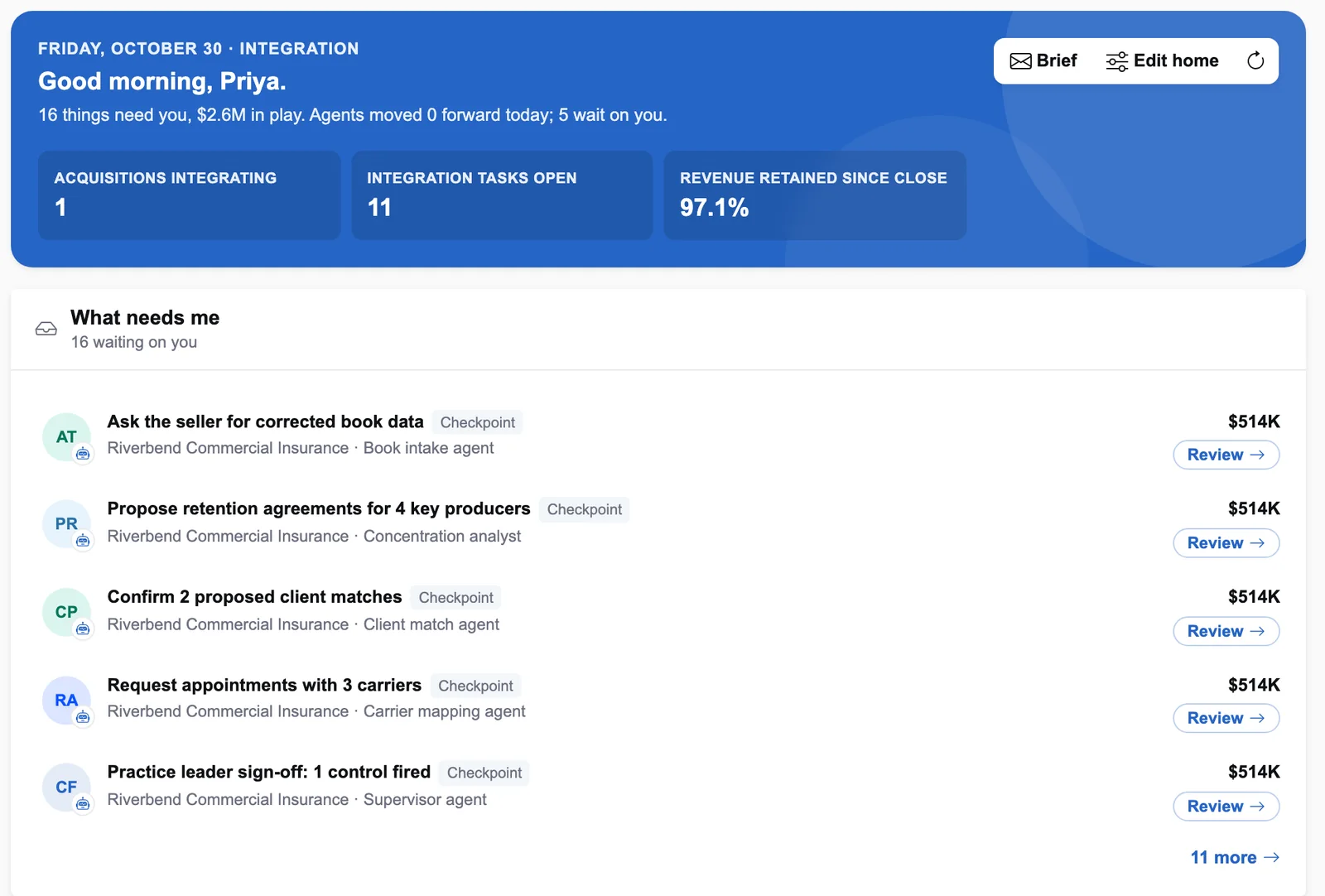
The acquisition copilot opens from the shell on any acquisition. It answers questions about the agency on screen — how sticky the book is, who the key producers are, whether the book supports the seller's revenue — by calling read-only lookups on that acquisition and answering from what they return, with the zone each source came from.
Seven read-only lookups
| Ask the copilot | Lookups it calls | What the answer covers |
|---|---|---|
| “How sticky is this book?” | Book headline; retention and growth | Client and revenue retention period over period, by producer and cohort; organic growth |
| “Which producers are key people?” | Concentration | Producer shares of revenue, key people and where each retention agreement stands; carrier shares; largest clients |
| “Does the book support the seller's revenue?” | Book headline; revenue quality and renewals | Book vs seller revenue, the asking multiple on each base, recurring vs contingent |
| “Which carriers do we need appointments with?” | Integration fit | Carriers against the acquirer's appointments, client matches, cross-sell gaps |
| “What did the agents prepare, and what fired?” | Findings and controls | Findings with review status, controls that fired, prepared decisions |
| “What's overdue in the integration?” | Integration plan | Tasks by owner, due date and status; the retention tracker |
What it will not do
- Act. It has no tool that writes. Accepting a decision, sending a request or moving a stage happens on the workspace.
- Reach outside scope. The lookups open the acquisition the asker can see, or nothing.
- Compute a figure. Figures come back from the lookups, which read the engines.
With the model switched off, the copilot answers with the acquisition's headline figures read directly and says that is what it did. On the practice leader's home, Ask my book asks across the whole pipeline the same way — “Which acquisition has the weakest retention?”

For the deal team
A quick answer about the deal without leaving the page, with the zone to open for the detail.
For IT
The shared insight_assist tool-answerer: tools, a scope opener, a system prompt from InsightPrompts, a fallback.
For corp-dev leadership
The copilot cannot be the place a number or an action comes from.
Questions we get asked
Can it see acquisitions I can't?
No. The scope opener checks the asker can see the acquisition before any lookup runs; outside scope it answers nothing.
Keep reading

The Acquisition Workspace: one page per agency
Seven zones, one stage strip, and every citation one click from the rows.
Read article
The seller's revenue the book won't support
An asking multiple of 2.9×, and a book 8.2% short of the seller's figure.
Read article
Two producers, 55% of the revenue
Key-person risk turned into retention agreements before signing.
Read article